

“Grace and salvation are always expressed in sacramental form. They do not come like a bolt from the blue. They find their path to the hearts of human beings through all manner of mediations. The mediations can change, but grace and faith cannot.” Leonardo Boff, Ecclesiogenesis
I don’t know about you, but I can hardly get through reading two lines of the news these days without my nervous system going totally haywire. Every day brings new heartbreaking horror to which there seems to be no helpful response. There is little that even begins to help me re-regulate, but poetry and prayer come close.
In this season of my life, I find balm in the words of writers like Anne Lamott, Mary Oliver, John O’Donohue, Joanna Macy, and new-to-me Pádraig Ó Tuama. And as some of y’all know, I often engage with the words of these folks with the ancient spiritual practice of lectio divina as my way of praying with and for the world.
Today, I’m inviting you to weave that ancient practice together with a more modern, artistic one - blackout poetry.
A quick refresher: lectio divina is a practice of reading or listening to a short passage of scripture slowly and mindfully - not to memorize it, but to be met by it. Read first to encounter. Read again to understand. Read once more to respond.
Blackout poetry is a kind of sacred scavenger hunt. You take a page that already exists - a newspaper, a sermon, a letter, a social media post, and yes, even scripture - and you begin to notice which words are quietly glowing for you, allowing that glow to shift your relationship with the words. Then you cover the rest with ink, paint, or tape, letting only those chosen words or phrases remain.
What’s left becomes a poem, a delicate or powerful story unfolding just for you. It’s part writing, part visual prayer, weeding out what no longer serves so a new meaning can take root.
Today, you’re invited to combine the two practices.
First, you’ll find a new, sacred, poetic thread in a biblical text (you won’t be struck by lightning, at least not literally), and then in the news of the world.
Lectio Divina Blackout Poetry with The Bible
Give yourself 30ish minutes for this practice.
Before the First Reading
Print or handwrite the text you’ll be engaging with onto a piece of paper or into your journal.
Take a deep breath and notice where you are sitting. Feel the place where your body meets what holds you. Notice the light in the room, where it softens and where it casts shadows. Listen for the sounds around you - distracting or soothing, or simply present.
Breathe.
First Reading
Read the passage slowly, listening with your heart for a word that shimmers for you.
This is your anchor word.
Circle it.
Breathe.
Second Reading
Read the passage again. Circle more words that resonate with your anchor word.
You are beginning to gather the connective tissue of a message meant for you.
Speak the circled words aloud.
What is your emerging poem asking you to notice?
Third Reading
Read once more. Circle any remaining words that complete your poem. It’s also okay to cross out words that you initially thought belonged, but you now realize they don’t fit.
Now slowly black out all other words.
Read your poem aloud.
Is there an invitation here to understand, to grieve, to act, to love differently? How might you respond to your encounter and understanding?
Here is a biblical text you can practice with today.
Matthew 25:34–46
34 Then the king will say to those at his right hand, ‘Come, you that are blessed by my Father, inherit the kingdom prepared for you from the foundation of the world; 35 for I was hungry and you gave me food, I was thirsty and you gave me something to drink, I was a stranger and you welcomed me, 36 I was naked and you gave me clothing, I was sick and you took care of me, I was in prison and you visited me.’ 37 Then the righteous will answer him, ‘Lord, when was it that we saw you hungry and gave you food, or thirsty and gave you something to drink? 38 And when was it that we saw you a stranger and welcomed you, or naked and gave you clothing? 39 And when was it that we saw you sick or in prison and visited you?’ 40 And the king will answer them, ‘Truly I tell you, just as you did it to one of the least of these who are members of my family, you did it to me.’ 41 Then he will say to those at his left hand, ‘You that are accursed, depart from me into the eternal fire prepared for the devil and his angels; 42 for I was hungry and you gave me no food, I was thirsty and you gave me nothing to drink, 43 I was a stranger and you did not welcome me, naked and you did not give me clothing, sick and in prison and you did not visit me.’ 44 Then they also will answer, ‘Lord, when was it that we saw you hungry or thirsty or a stranger or naked or sick or in prison, and did not take care of you?’ 45 Then he will answer them, ‘Truly I tell you, just as you did not do it to one of the least of these, you did not do it to me.’ 46 And these will go away into eternal punishment, but the righteous into eternal life.”
Pause. Breathe.
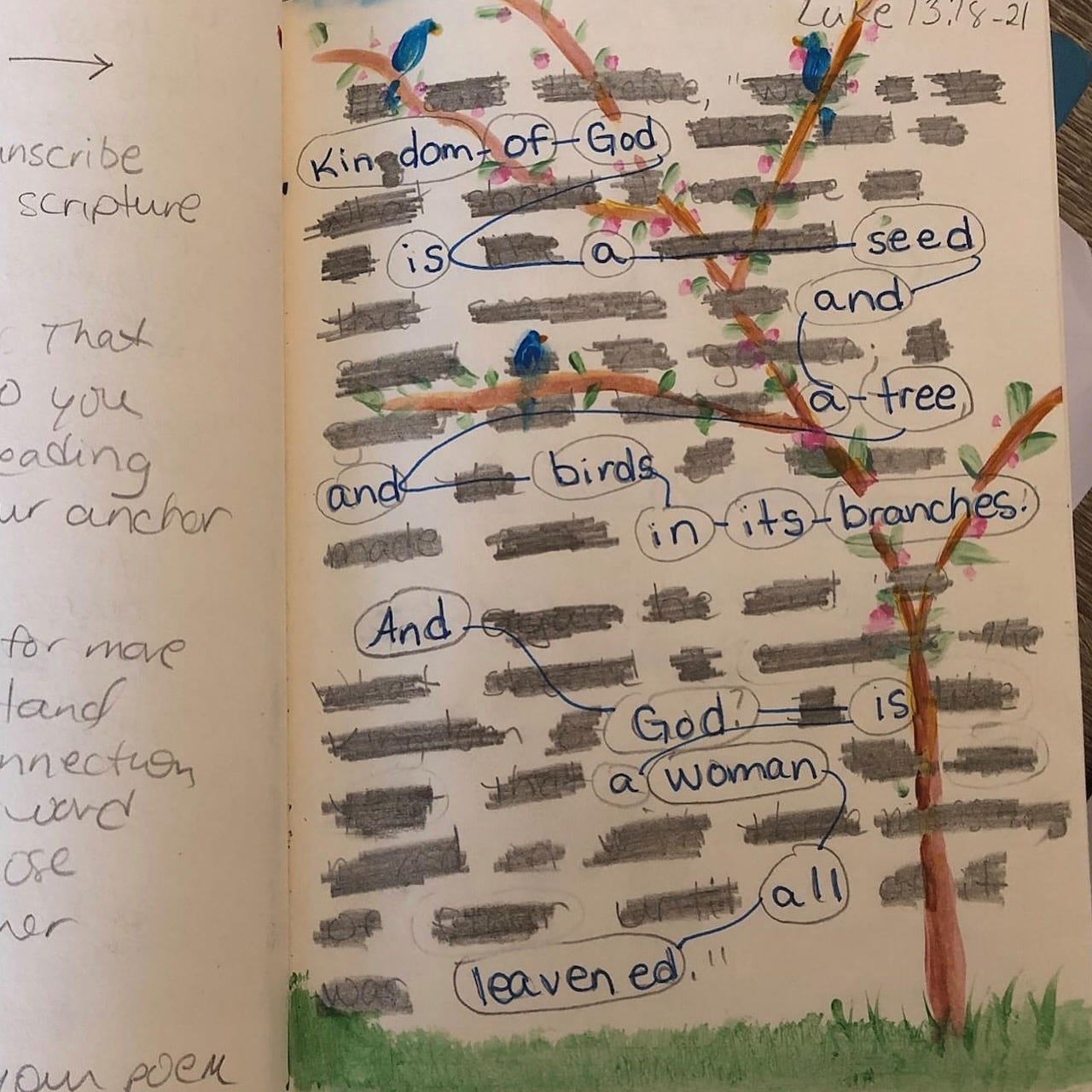
Here’s an example with another snippet of scripture from my journal
Lectio Divina Blackout Poetry with the News
“We must hold the Bible in one hand and the newspaper in the other.”
I think Karl Barth’s fuller wisdom matters: “Take your Bible and take your newspaper, and read both. But interpret newspapers from your Bible.” (Time Magazine, May 1, 1966.)
What might emerge if you approached a challenging news article with this tactile spiritual practice? When reading about the heinous murder of Renée Nicole Good, or the unlawful invasion of Venezuela, or the violent protests in Iran, what truth, what hope, what call to courage might be lurking among the written words?
Here’s the invitation
Find a news article that calls to your heart.
Within that article, find a couple of paragraphs that are particularly difficult to take in.
Copy and paste that bit into a document that you can print out. Or, handwrite the selection into your journal.
Then walk the passage through the same slow, sacred process outlined above.
Read first to encounter. Read again to understand. Read once more to respond.
Circle your anchor word. Circle other words and phrases that shimmer for you. Circle any last words and black out the rest.
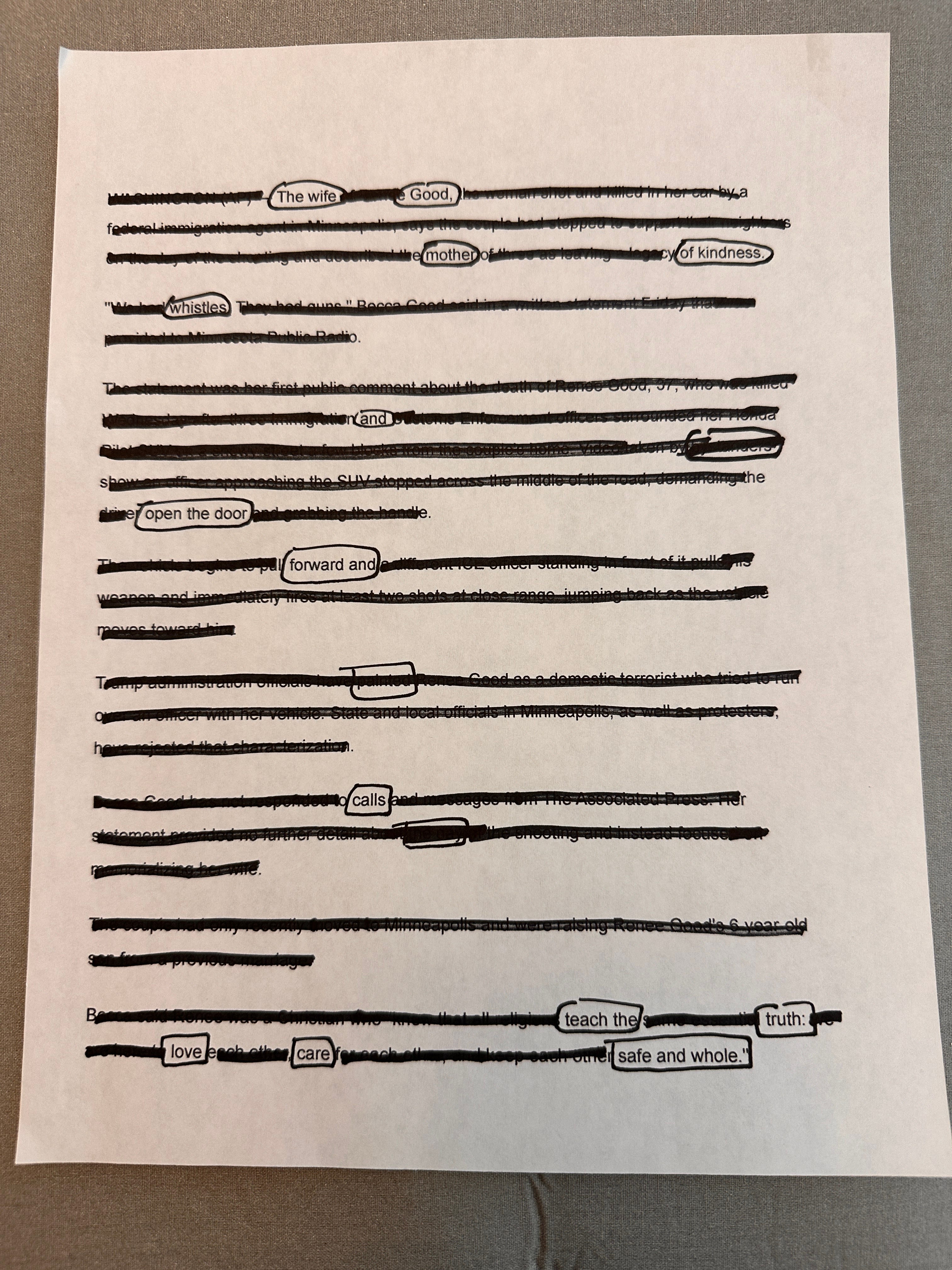
Here’s an example with a section of a post from PBS News.
And if you feel called to, and safe to do so, I hope you’ll share your poems with someone you trust. Maybe even here.